Leads
Your prospect pipeline — capture enquiries, work them through your stages, and convert the good ones into clients.
A lead is someone who's interested but isn't a client yet. This is the front of your funnel: capture → qualify → convert, so nobody who enquired quietly disappears because you forgot to follow up.
Open Leads in the sidebar, under Sales.
Who can see this: Leads is limited to owner, admin, dietician, nutritionist, coach, and receptionist roles. If it isn't in your sidebar, that's why.
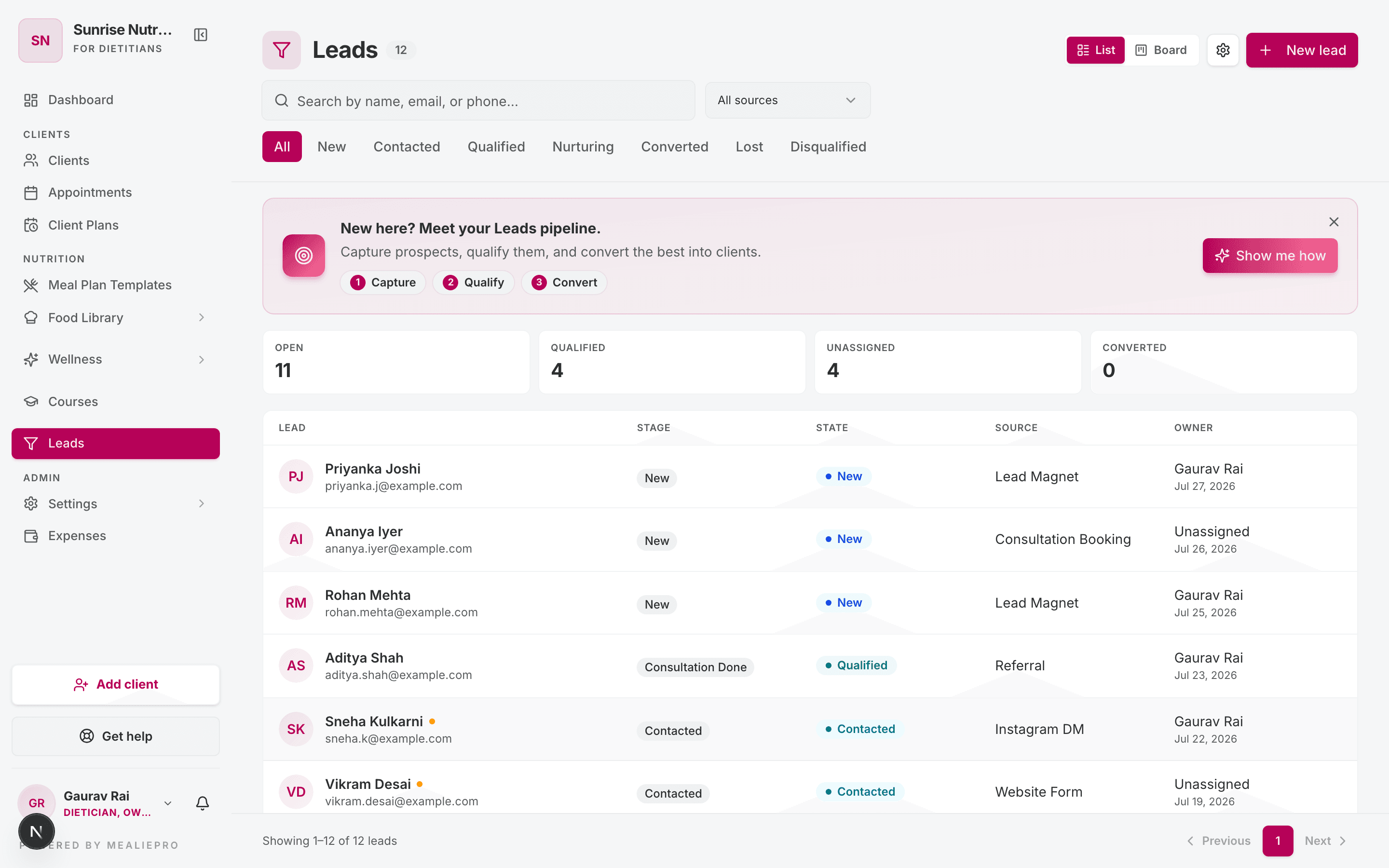
The list
Four tiles across the top give you the state of the funnel at a glance — Open, Qualified, Unassigned, Converted. Unassigned is the one to watch: those are leads with nobody's name on them, which is how enquiries get dropped.
Below that, search by name, email, or phone, and filter by status: All · New · Contacted · Qualified · Nurturing · Converted · Lost · Disqualified.
Rotting leads
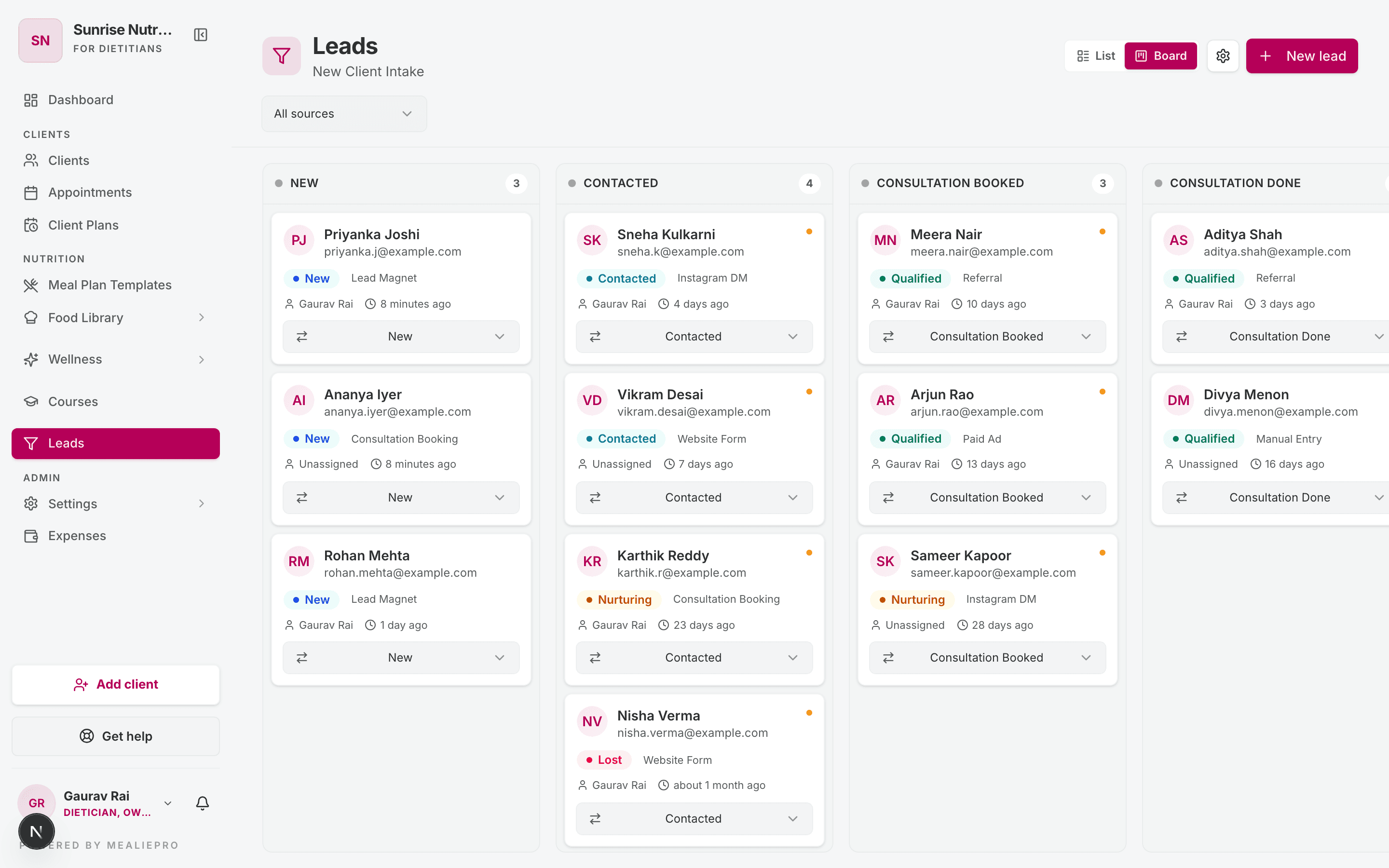
A lead that hasn't moved past its stage's threshold gets flagged as rotting. It's a nudge, not a judgement — it means this one has sat still long enough that it needs either a follow‑up or an honest Lost.
List or board
Toggle between two views:
- List — dense and searchable. Best for finding a specific person.
- Board — a Kanban card per lead, in columns by stage. Best for working the pipeline: see where everyone is and move cards forward.
Getting leads in
Automatically — anyone who signs up through your public link lands here on their own. Attach a lead source tracking code (?src=…) to the link and they're tagged with where they came from, so you can tell which channel actually produces clients rather than which one produces clicks.
By hand — click New lead and enter them. Fine for a phone enquiry or a referral mentioned in passing.
Working a lead
Open any lead for its detail page. The timeline is the useful part — log every touch as you go:
Note · Call · Email · WhatsApp · SMS · Meeting
Log the call right after you make it. A pipeline is only as good as the notes in it, and the value shows up three weeks later when you can see exactly what was said and when.
You can also Disqualify a lead (never a fit) or move it to Lost (was a fit, didn't happen) — worth keeping distinct, because one is a filtering problem and the other is a sales problem.
Converting to a client
When a lead is ready, hit Convert. It carries their details straight into a new client record so you're not retyping anything.
Qualify first. Convert asks you to qualify the lead before it'll proceed. That's deliberate — it keeps "Converted" meaning something in your numbers.
Moving a lead into a stage marked as won offers the conversion automatically, so the board and the client list stay in step.
Make the pipeline yours
The default stages are a starting point. Under Settings → Pipeline you can rename, reorder, add, and remove stages so the board mirrors how your practice actually works — and manage the lead sources behind those tracking links.
Common workflows
"Set up the pipeline for how I actually sell"
- Settings → Pipeline — rename the stages to your real steps (e.g. Enquiry → Discovery Call → Proposal → Signed).
- Add a lead source for each channel you use — Instagram, referrals, your website.
- Put each source's
?src=link in the matching place. - Work the board from left to right.
"Follow up on everything that's gone quiet"
- Open Leads, look for the rotting flags.
- Work down them: log a call or a WhatsApp on each.
- Anything genuinely dead → Lost, with a note saying why.
What's next
- Settings › Pipeline — stages and lead sources.
- Client onboarding — where a converted lead lands.
- Appointments — book the discovery call.